

.jpg?width=1440&height=960&name=brooke-cagle-8jp-6SjVibM-unsplash%20(1).jpg)
Key Takeaways
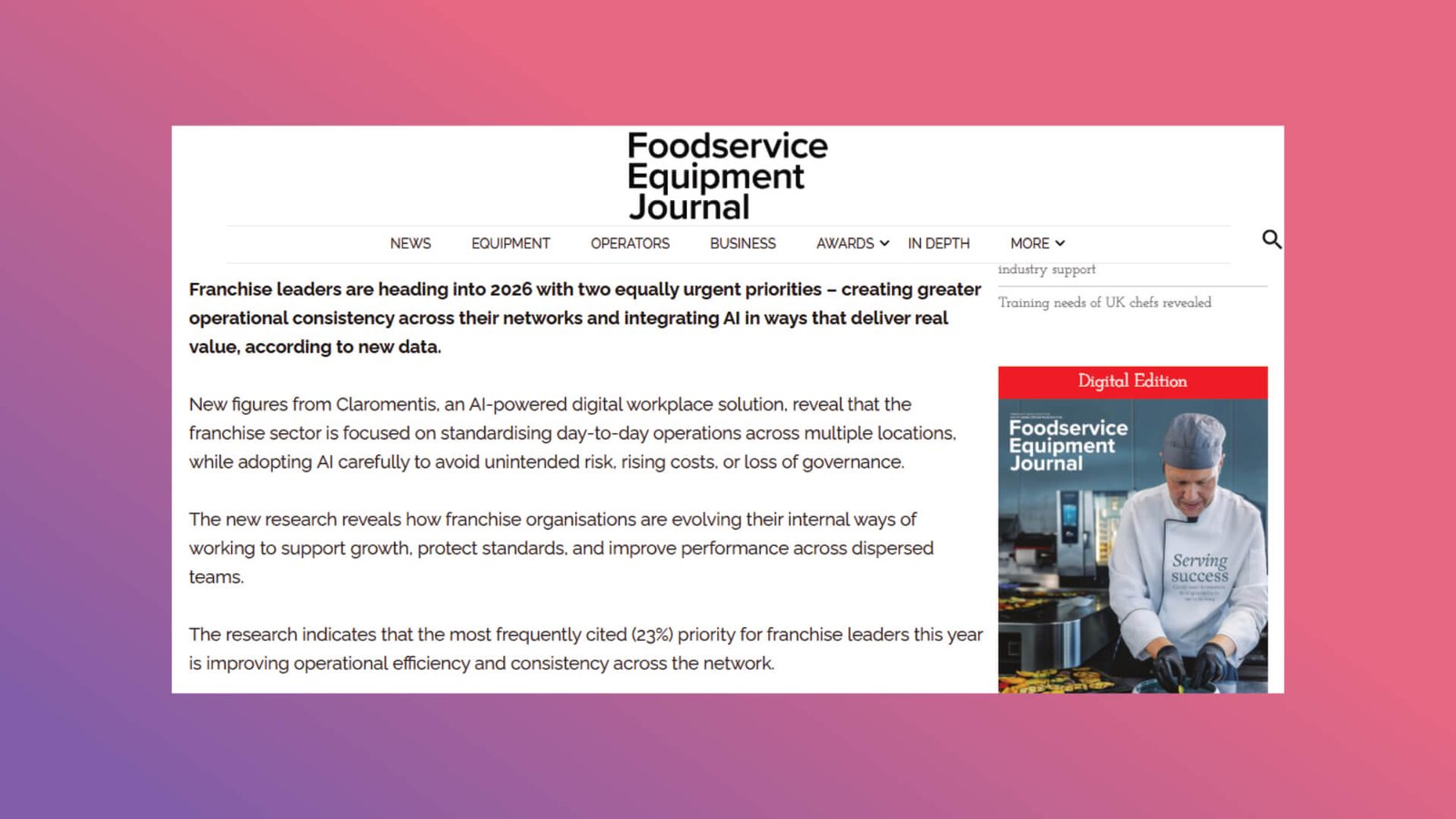
Our CEO, Nigel Davies, was recently featured in Foodservice Equipment Journal with a piece on what's really driving franchise transformation in 2026. The article draws on new Claromentis research and the message is clear: franchise leaders want AI, but not at the expense of the operational consistency that holds their networks together.

Streamline franchise operations with Claromentis
Two priorities, one problem
Franchise leaders heading into 2026 have two things at the top of their to-do list:
- Improving operational consistency across their network (23%) and;
- Integrating AI in ways that actually deliver value (22%).
On the surface, these look like separate goals. But they're actually the same problem.
AI only works well when it's built on a foundation of standardized processes, clear policies, and reliable information. Without that foundation, you're not adding intelligence to your operations — you're adding complexity to an already complicated operating model.
And in franchising, complexity has a habit of compounding. One head office. Dozens, sometimes hundreds, of locations. Thousands of employees who need to do things the same way, every day. If the basics aren't consistent, AI has nothing solid to build on.
That's why these two priorities aren't competing; they're interdependent. You can't have one without the other.
AI without governance is just another risk
There is a clear appetite for AI across the franchise sector, but there are also clear risks. This is why franchises are approaching it with caution.
As Nigel puts it in the article, franchise organizations want AI that strengthens control, not undermines it. That means applying it in ways that are secure, measurable, and aligned with how the business actually runs.
Think about what uncontrolled AI adoption looks like in a multi-site environment.
One franchisee harnesses a chatbot to draft customer communications; another uses a tool to auto-generate training materials; and a third experiments with AI-powered scheduling.
None of them use the same tools, there's no central governance, and the use cases do not align with head office's acceptable use policy. Multiply that across your network and you've got a real problem on your hands.
The risk isn't that franchises will reject AI — that ship has sailed. It's that they'll adopt it in a hundred different ways, with no consistency or oversight. And therefore, no way to see if it's working, if it’s secure, or if it’s compliant.
Franchise networks need AI that sits within their existing governance structure, not alongside it. That means adopting AI through a single platform, with clear guardrails, that head office can manage and franchisees can trust.
Compliance is a consistency problem
The research also found that 17% of franchise leaders are prioritizing compliance and audit readiness in 2026. But here's the thing: compliance in franchising shouldn't be a standalone initiative. It needs to be a byproduct of consistent, effective operations.
When a franchisee in Manchester follows the same process as their fellow franchisees in Edinburgh, Vancouver, Tilburg or Nashville, compliance takes care of itself. When they don't, gaps appear. And in hospitality, where regulations around food safety, advertising, and employment law shift regularly, those gaps can get expensive quickly.
Compliance often depends on how quickly people can access the right information and follow the right steps. That's especially true when franchisees and frontline employees are busy and may not be compliance specialists.
So improving audit readiness isn't about adding more rules. It's about making the rules easy to follow and implement. Clear documentation. Simple processes with reliable ways of showing what's been shared, read, and completed. Get that right, and compliance becomes less of a burden.
The case for consolidation
In the article, Nigel makes a point about something less obvious but just as important: the productivity gains that come from consolidating tools into a single franchise management software solution.
In hospitality franchises, this matters more than most. Teams are dispersed. Turnover is high. People work shifts on zero hour contracts, rather than regular hours. If finding the latest menu update or checking a policy means logging into three different systems, it won't happen. Or it'll happen inconsistently, which in franchising, amounts to the same thing.
When you bring communications, training, policies, and workflows into one place, the benefits go beyond just franchise automation. People find what they need faster. Changes are communicated once, not duplicated across platforms. And small, hard-to-measure snags in multi-site operations start to disappear.
Read the full article on the Foodservice Equipment Journal website.
You can also explore the findings from our franchise digital workplace research here.
Running a hospitality franchise? Let's talk.
If you're trying to balance AI adoption with the operational consistency your network depends on, we should have a chat. Book a discovery call and we'll show you how a unified digital workplace can help you do both.
Reach your
full potential
Achieve growth without compromise.
Scale your franchise network.