

.svg)
Key Takeaways
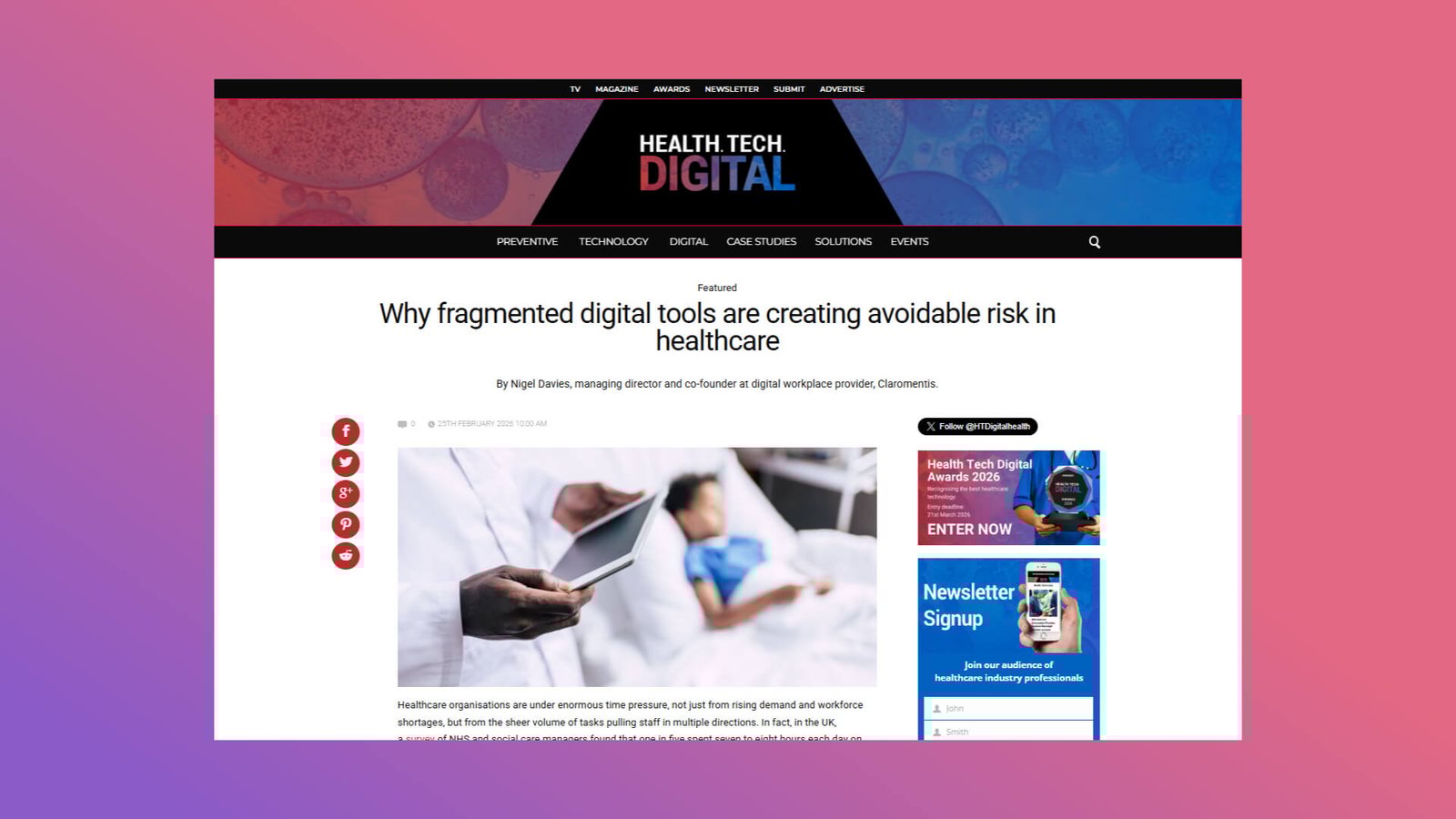
Our CEO, Nigel Davies, recently wrote a Health Tech Digital article on how fragmented digital systems quietly create operational risk across healthcare organizations. He argues that you don’t need more tools, you need connected workflows and a single operational front door for staff.

Streamline healthcare operations with a unified digital workplace
The admin burden is real
Healthcare staff are losing hours every day to administrative work. And fragmented systems are only making things worse.
1 in 5 NHS and social care managers spend 7 - 8 hours a day on admin, with many reporting that they lose over 20 hours a week to bureaucracy and form-filling instead of patient-centered work.
This isn't a workforce problem; it's a sign your systems don't work. When staff have to navigate multiple platforms just to complete routine tasks, admin burdens grow exponentially. This is far from ideal — especially in a sector already under pressure from rising demand and workforce shortages, where every hour spent wrestling with disconnected tools is time taken away from critical patient care.
Specialist tools lead to fragmented outcomes
The problem doesn't lie with one single platform. It lies with the accumulation of many.
Most of these tools were introduced over time to meet a specific regulatory or operational need:
- Risk and incident reporting for compliance
- Learning management to train frontline teams
- Document management to provide access to information
- Automated processes to ensure consistent operations across every site
Individually, these platforms do their job. But the processes that matter most in healthcare rarely sit within a single function. Incident management, policy changes, mandatory training, and service change approvals cut across multiple systems, teams, and stages.
When these end-to-end processes aren't visible in one place, coordination becomes a manual exercise. Your operations live in emails, shared drives, local trackers, and within your institutional memory. It’s your job to remember where everything is, navigate each platform, and find what you’re looking for.
This works, until it doesn’t. When someone leaves, or a shift changes, or an audit lands, you find out how unstructured your operations have become.
Hidden risk in the gaps
In healthcare, early intervention depends on visibility. If incidents are logged in one system, follow-up actions tracked in another, and training completion recorded somewhere else entirely, patterns don't surface until someone manually pulls the data together.
By that point, it’s too late. A problem that could have been solved quickly has compounded into something more serious.
For operational and frontline teams, this fragmentation also creates day-to-day uncertainty. They may ask themselves:
- “Which system holds the latest policy?”
- “Which form applies to this situation?”
- “Where do I check whether training has been completed?”
In a multi-site healthcare environment with complex shift patterns, that kind of ambiguity slows your operations, leading to a reduction in care quality and unsatisfactory patient outcomes.
A front door, not another system
Don’t add yet another standalone tool. Create a single operational front door that connects the communication, processes, knowledge and training your staff rely on.
This doesn’t mean ripping out your existing specialist systems. It means complementing them.
Start by identifying a small number of critical workflows — incident handling, safeguarding escalations, policy updates, mandatory training compliance — and creating clear paths that cut across systems.
From there, it's about giving staff one place to access everything they need at any time, anywhere, and on any device. Including:
- Policies in a knowledge base.
- Training through an LMS.
- Standardized forms that route information to the right people.
- Task management that tracks progress automatically.
- Role-based views. Meaning ward nurses see only what's relevant to them.
If you connect your workflows in this way, operational data becomes useful again. Leaders can see in real time how many incidents have been raised, how quickly they're resolved, whether actions are completed, and where similar issues keep recurring. Assurance becomes part of how people work, not a separate reporting exercise bolted on afterwards.
Read Nigel's full article on the Health Tech Digital website.
Working in healthcare? Let's talk.
If your teams are spending more time navigating systems than delivering care, we should have a chat. Book a discovery call and we'll show you how a unified digital workplace can help you close the gaps.
Modernize your healthcare services
We help healthcare organizations enable staff, streamline services, and bolster compliance.